Showing posts with label outdoors. Show all posts

Wednesday, December 16, 2015

TNR - Trap, Neuter, Return

Mason, here!  Talking to you about a very important topic with regard to felines who live outdoors.  We all know the problem with feral cat colonies and cats who live outdoors: a lot of them aren't spayed/neutered and their population keeps increasing!!  Trap-Neuter-Return (called TNR) is a humane and effective approach for cats living outside.  Scientific studies show that Trap-Neuter-Return improves the lives of feral cats, improves their relationships with the people who live near them, and decreases the size of colonies over time.
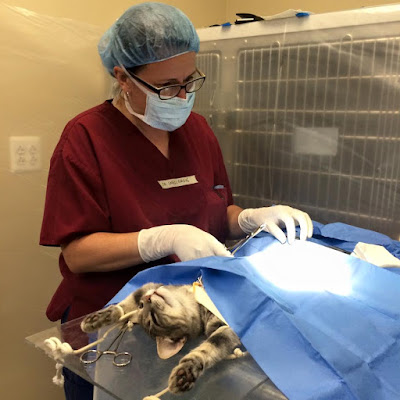
Trap-Neuter-Return is exactly what it sounds like: Cats are humanely trapped and taken to a veterinarian to be neutered and vaccinated, and to have their ears tipped to indicate that they have been neutered and returned to the outdoors.  This practice stops the breeding cycle of cats and improves their lives.   Since most feral cats are not adoptable, they have been trapped by animal control services and subsequently killed in pounds and shelters due to their wild nature and lack of domesticity.  Trap-Neuter-Return helps prevent the need for euthanizing these felines while allowing them to live without adding to the problem of overpopulation.

Our own Dr. Snellgrove and Vet Assistant Elizabeth Board participate in TNR clinics and love talking about their experiences in aiding outdoor felines!

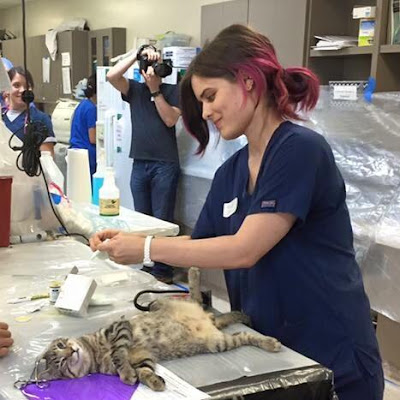
 
Here, Elizabeth is helping another volunteer to prep cats for surgery. This involves removing hair from the surgical site and scrubbing it clean.
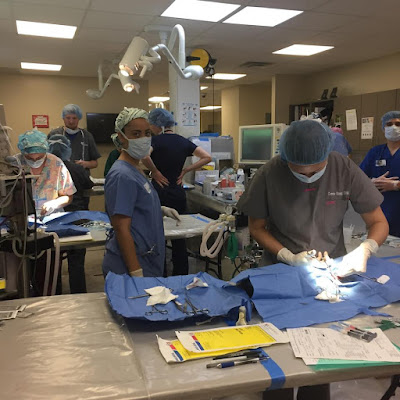
 
Here, Dr. Snellgrove (in the red top) and another doctor perform neuter and spay surgeries while technicians monitor the patients and stand by to give additional anesthesia if necessary.  The doctors have to work very fast because the felines are anesthetized with injectable medications versus gas anesthesia, to prevent any medical complications.
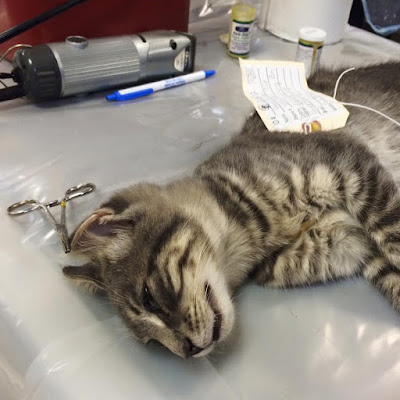
  
Don't worry, this cat is just asleep!  Each cat has an ID number and paperwork that accompanies it, so there's no worry of getting the animals mixed up.  You may also see animals laid out on trays in preparation for the surgeries - this helps cut down on time that the cats have to stay asleep so the neuter and spay surgeries can be done quickly and efficiently.  
This kitten just had her ear tipped in surgery prep (she's asleep, too!).  The clamp will stay on through her surgery and be removed in recovery.  Chances are if you see a cat with a clipped ear, it was once an outside cat who has gone through a TNR program and was adopted!

With Trap-Neuter-Return, veterinarian professionals can stabilize the feline outdoor population humanely, improve the cats’ lives, save taxpayer dollars, address neighbors’ concerns, and help the entire community reach a solution that benefits everyone!  If you are interested in helping with Trap-Neuter-Return programs, you can contact Alley Cat Allies or Metro Ferals for more information.  Here at Great Falls Animal Hospital, we work with 4Paws Rescue Team directly to care for their cats and spay and neuter them!

I hope that sheds some light on a very interesting and life-saving practice that we believe in wholeheartedly!  
Well, kittens, that's all for now.  I'm going to snuggle up here and wait for Christmas!

Til next meow,


MASON


Great Falls Animal Hospital

703-759-2330
POISON CONTROL HELPLINE
PET POISON HELPLINE: (800) 213-5774
ASPCA POISON CONTROL(888) 426-4435

24 EMERGENCY FACILITIES
THE HOPE CENTER- Vienna: (703) 281-5121
THE LIFE CENTRE- Leesburg: (703) 777-9968

Thursday, September 4, 2014

Why Microchipping Your Pet Works

Hello, blogger fans!  It has been a long and fun summer and everything is now winding down for the fall.  That also means lots of moving, kids going to school and moving for college, and fall changes.  So, today, I would like to talk to you about microchipping.

What is microchipping, you may ask?  Well, a microchip is a tiny electronic device (about the size of a grain of rice) that uses radio waves to transmit stored information when it is read by the right kind of scanner.  Microchips for pets store a unique identification number and do not need a power source, and they have no moving parts, so they do not wear out.  Microchips are made of a material that is compatible with body tissues, so rejection and infection at the site are rare.  After injection, the microchip becomes encased in the tissue at the injection site (usually around the back and shoulders). It may move slightly, but it usually stays at or near the place it was injected.  To read the chip, a compatible scanner must be passed over it.  Different microchip companies use different chips; however, there are scanners that can read all kinds of chips.


To complete the microchipping process, you must register your pet’s microchip with the microchip company.  Unless the microchip company has your information, there is no way for the identification number on the microchip to link you with your lost pet!  This is the number one way to reunite an owner with their pet, and we here at our hospital have many happy stories about reuniting pets and owners due to a microchip and the information attached with the microchip.


So, what happens if your pet becomes lost?  When a lost or injured pet is taken to an emergency room, veterinary office, or shelter, he or she can be scanned for the presence of a microchip.  If the pet has a chip, the scanner reads the pet’s identification number.  If the chip has been properly registered, the shelter or hospital can provide the number to the microchip company, which maintains the owner's contact information.  The microchip company or hospital then contacts the owner, and the pet can be reunited with his or her family!

The use of tattoos as permanent identification for pets has for the most part been made obsolete by microchip technology.  A microchip and an ID tag, however, work best together, and I recommend that every pet have both.  The most important thing to remember about any form of pet ID is to keep your contact information current!  If you move or change your phone number, update your microchip information immediately.  Don’t wait, because a move is a high-risk time when your pet is more likely to slip out and go missing.  And get a new ID tag as well: Many pet-supply stores have machines that make them while you wait, in five minutes or less!  No excuses!

The bottom line, though, is that if your pet is lost, you want to make sure you have done everything you can to make his return home as quick and easy as possible.  You don’t want to have to rely on posters plastered around town or hope a harried shelter worker will have the time and resources to figure out where your pet belongs.  Tags, microchips and other innovative ways of identifying pets all help to produce happy endings for lost pets and their owners.


To sum up, here's why you should use a microchip as an identifier for your pet:

  • Microchips are a way of permanently identifying your pet.
  • Microchips must be registered with a microchip company to reunite you with your pet.
  • Microchipping is a simple, quick procedure that can be performed by your veterinarian.
  • Many lost pets are never returned to their owners because they do not have any form of identification.

  • To keep your pet safe in the face of the unknown, try a microchip today!  Coupled with an ID tag or ID collar, your pet will have the best chance possible to be reunited with you.  And I should know - I'm microchipped, too!


    Til next meow,
    

    Mason

    
    Great Falls Animal Hospital

    703-759-2330
    POISON CONTROL HELPLINE
    PET POISON HELPLINE: (800) 213-5774
    ASPCA POISON CONTROL: (888) 426-4435

    24 EMERGENCY FACILITIES
    THE HOPE CENTER- Vienna: (703) 281-5121
    THE LIFE CENTRE- Leesburg: (703) 777-9968
     

    Tuesday, June 3, 2014

    Do We Love Our Dogs More Than Our Cats?

    Hello, all!  Mason here, checking in with you for another newsletter!
     
    I've been thinking a lot lately, and I feel we should discuss a topic very close to my heart: Feline Health Care.  Did you know that there's still this misconception that cats don't need regular health care?  That your cats don't need to be seen but every 3 years when their vaccines come up due, or don't need to be seen at all except for when there's a problem?  Well, I'm here to say that you feline friends need to be seen by a veterinarian at least once a year, and twice if they have health issues or are older.
     
    I know you're thinking, "But, Mason, I can't catch my cat to bring him in!" or "My cat never goes outside and so she doesn't need to be seen."  Cats are the wildest of our domestic pets and it is their instinct to hide illness until they absolutely can't.  Some cat owners bring their pet to our office in very dire conditions, guilt-ridden that they didn't realize it needed care.  And there's also the opinion of cat owners to consider - there's a very "Town Mouse, Country Mouse" view of how cats should be treated, as either outdoor or barn cats, or as house cats who live in relative luxury.  Any animal, no matter how big or how small, deserves to be in good health!


    According to the American Veterinary Medical Association (AVMA), here are some facts regarding feline health check ups. 
    • More than half of owned cats (52 percent) hadn’t been to the vet within the past year.
    • Older cats see vets less often than younger cats do.
    • Meanwhile, 95 percent of veterinarians believe cats should receive annual checkups, and 72 percent believe that wellness exams are the most important service we provide.
    • And get this: Only about half as many cats get annual checkups as dogs.
    So what’s up with that?

    A Number of Contributing Factors

    1. The economic impact of the recession. The study was conducted during the height of the economic downturn.
    2. Fragmentation of veterinary services. Lots of choices in veterinarians and specialists can be confusing and can actually interrupt access to vet services.
    3. The use of the Internet versus office visits. Lots of cat owners seek help in inexpensive places first.
    4. Feline resistance. Cats don’t like going to the vet.
    5. Perception that regular medical checkups are unnecessary. Veterinarians aren’t always very good at communicating the importance of regular vet visits.

    All of that makes sense!  But that still doesn’t explain why cats receive less care than dogs do.  After all, all of these causes could be applied to the case of dogs, too. Which is why I think this issue is less to do with economics and more about why cats garner less attention than their canine counterparts.


    So, why should you bring your cat in for check ups regularly?  Even if your cat seems healthy on the outside, an underlying problem may be lurking on the inside.  Fecal exams, blood and urine tests, and other tests that screen for infectious diseases, such as feline immunodeficiency virus (FIV) and feline leukemia virus (FeLV), may be required, based on your cat’s age and lifestyle. 

    Even if your cat spends most or all of its time indoors, it may still be at risk for certain preventable viral diseases. Your veterinarian will assess your cat’s risk and develop a vaccine protocol tailored specifically to its needs. 

    Cats are prime targets for parasites such as fleas and ticks, not to mention the ones we can’t see like heartworms (which are spread by mosquitoes) and intestinal parasites. Your veterinarian will discuss the best options to keep your cat free and clear of these dangerous pests. 

    Dental disease isn’t just for dogs—cats are susceptible, too. Your veterinarian will examine your cat’s mouth and determine if further action, like a full oral health assessment and treatment under anesthesia, is needed to keep your cat’s teeth and gums in good shape. 

    Just as your cat needs to be physically healthy, it needs to be emotionally healthy, too. Your veterinarian will ask questions about your cat’s environment—whether there are other pets or children in the house and how your cat interacts with them, what kind of playful activities your cat participates in, and so on—and inquire about any behavioral issues that need attention.


    So, I highly recommend that cat owners everywhere try their best to bring their cats in to a veterinarian at least once or twice a year!  Our health is just as important as dogs' health, plus we tend to keep it a secret from you - being proactive and taking felines in regularly will help eliminate emergencies and surprises! 


    Til next meow,
    

    Mason

    
    Great Falls Animal Hospital

    703-759-2330
    POISON CONTROL HELPLINE
    PET POISON HELPLINE: (800) 213-5774
    ASPCA POISON CONTROL: (888) 426-4435

    24 EMERGENCY FACILITIES
    THE HOPE CENTER- Vienna: (703) 281-5121
    THE LIFE CENTRE- Leesburg: (703) 777-9968
     
     
    http://veterinarymedicine.dvm360.com/vetmed/data/articlestandard//vetmed/182014/842022/article.pdf

    Wednesday, April 16, 2014

    Spring is Here!

    It has been quite a long winter and we are so glad it is finally, finally over...finally...we hope.

    And with the Spring comes many things that you should think about for the safety of your pets and wildlife around you!


    With Easter upon us, no doubt there have been lilies and daffodils and other springtime flowers adorning your home and yard.  But did you know that some lilies are poisonous to cats and even dogs?

    There are benign and dangerous lilies out there, and it’s important to know the difference!  Benign (or non-toxic) lilies include the Peace, Peruvian, and Calla lilies, which contain insoluble oxalate crystals that cause minor signs such as tissue irritation to the mouth, tongue, pharynx, and esophagus.  Clinical signs of drooling, pawing at the mouth, foaming, and vomiting may be seen.

    The more dangerous, potentially fatal lilies are true lilies of the Lilium or Hemerocallis species.  Examples of some of these dangerous lilies include the Tiger, Day, Asiatic hybrid, Easter, Japanese Show, Rubrum, Stargazer, Red, Western, and Wood lilies – all of which are highly toxic to cats!  Even small ingestions (such as 2-3 petals or leaves) – even the pollen or water from the vase – can result in severe, acute kidney failure.  Lily of the Valley is also included and though it does not cause kidney failure, it can cause life-threatening heart arrhythmias and death when ingested by dogs or cats.

    If your cat is seen consuming any part of a lily, bring your cat (and the plant) immediately to a veterinarian for medical care.  The sooner you bring in your cat, the better and more efficiently the lily poisoning can be treated.  Decontamination (like inducing vomiting and giving binders like activated charcoal) are imperative in the early toxic stage, while aggressive intravenous fluid therapy, kidney function monitoring tests, and supportive care can greatly improve the prognosis.  Intravenous fluids must be started within an 18 hour window for the best outcome.

    Common signs to watch for if your cat has eaten lilies:
    • Inappetance
    • Lethargy
    • Hiding
    • Vomiting
    • Diarrhea
    • Halitosis
    • Dehydration
    • Inappropriate urination or thirst
    • Seizures
    • Death

     
    As springtime begins so too does “kitten season,” and Alley Cat Allies, the nation’s largest advocacy organization dedicated to cats, offers ways people can help cats and kittens this season.
     
    If you come across a kitten outdoors, you may be tempted to bring her home with you, but that may not be the best thing for the kitten,” said Becky Robinson, president and founder of Alley Cat Allies. “Deciding whether to take a kitten home with you or leave her where she is should be carefully considered based on the individual kitten’s situation and age.”

    Alley Cat Allies offers the following tips to help kittens this season:
    1. Leave kittens with mom. Like all babies, kittens are best left with their mothers who instinctively know how to help their kittens grow up to be strong and healthy cats.  Neonatal kittens, 4 weeks old or younger, need constant care and still depend on mom for 100 percent of their food.  Kittens 5 to 8 weeks old can begin to eat wet food, but are still being weaned.  If you know the mother is present, it is best to leave kittens with her.  To determine whether the mother is caring for the kittens, wait and observe for two to four hours to see if the mother returns.  The mother could just be out looking for food. If she doesn’t return within a day, the kitten could be abandoned.  A young kitten living outdoors who does not have a mother present should be taken in and fostered.  If the kitten is not weaned, she will require bottle-feeding and round-the-clock care.
    2. Do not bring a just born kitten to an animal shelter.  Most shelter employees are not equipped or trained to provide round-the-clock care for neonatal kittens (up to 4 weeks of age).  If a kitten cannot eat on her own, she will likely be killed at a shelter.  Realistically, it is never a good idea to take a cat to a shelter.  More than 70 percent of cats who enter shelters are euthanized there, and that number rises to virtually 100 percent for feral cats taken to shelters.  


    And while we are talking about abducting or displacing cute baby animals, let's also talk about bunnies, squirrels, and birds.  The # 1 rule about wildlife is: DON'T TOUCH IT.  Unless the animal is obviously injured, emaciated, or you know the mother has not been by to take care of the babies, do not pick them up and bring them into your home as a pet.  Wild animals are not meant to be pets! 

    Signs that a wild animal needs your help:
    • A cat or dog presents the wild animal to you
    • Evidence of bleeding
    • An apparent or obvious broken limb
    • A featherless or nearly featherless bird on the ground
    • Shivering
    • A dead parent nearby
    If you observe the above signs, find help for the animal and safely capture and transport him or her to the appropriate place for treatment.  Once you're sure the animal needs your help, call a wildlife rehabilitator for assistance. If you’re unable to locate a rehabilitator, try contacting one of the following:
    • Local animal shelter or humane society
    • Animal control agency
    • Nature center
    • Veterinarian (including us!)
    Once you've contacted someone who can help, describe the animal and his physical condition as accurately as possible.  Unless you are told otherwise, here's how you can make an animal more comfortable for transport or while you're waiting for help to arrive:
    • Never handle an adult animal without first consulting with a wildlife professional. Even small animals can injure you.
    • Put the animal in a safe container. For most songbirds, a paper bag may be used for transport. For larger birds or other animals, use a cardboard box or similar container. First, punch holes for air, from the inside out, and line the box with an old T-shirt or other soft cloth.
    • Put on thick gloves and use a towel or pillowcase to cover the animal as you scoop him up gently and place him in the container.
    • Do not give the animal food or water: it may cause him to choke, develop digestive problems, or drown. Also, many injured animals are in shock, and eating or drinking can make it worse.
    • Place the container in a warm, dark, quiet place—away from pets, children, and noise—until you can transport the animal. Be sure to keep the container away from direct sunlight, air conditioning, or heat.
    • Transport the animal as soon as possible.
    • While transporting the animal, leave the radio off and keep talking to a minimum.

    With all that said, I think I'm going to find a nice spot of sun before the winter comes back...again...with snow...(grumble, grumble).

    Til next meow,
    

    Mason

    
    Great Falls Animal Hospital

    703-759-2330
    POISON CONTROL HELPLINE
    PET POISON HELPLINE: (800) 213-5774
    ASPCA POISON CONTROL: (888) 426-4435

    24 EMERGENCY FACILITIES
    THE HOPE CENTER- Vienna: (703) 281-5121
    THE LIFE CENTRE- Leesburg: (703) 777-9968
    

    http://www.cbsnews.com/news/easter-lilies-toxic-for-cats-fda-warns/

    http://www.lifewithcats.tv/2014/04/09/2-5-tips-to-help-kittens-this-spring/

    http://www.humanesociety.org/animals/resources/tips/injured_orphaned_wildlife.html#.U07ouJqPLow

    Tuesday, January 29, 2013

    Brrr! It's cold outside!

    Happy Mew Year everyone!! I realize it’s been awhile since my last blog and I apologize.  I decided I needed some time to de-stress (since being a cat is tough) and took a nice long vacation to the green exam room.  It was everything I thought it would be; mostly because it looks the same so I knew how it would be but it was amazing nonetheless.  Nothing terribly
    exciting in my world, though I started to put treats towards my 401k.  I can’t even fathom my senior years without them and I refuse to go back to selling catnip on the side.

    Mason all snuggled up for winter
    Speaking of things I can’t fathom, what is the deal with this below freezing weather we’re having?  I personally need heat and do not appreciate that I am unable to look out the window because Mother Nature is bitter.  You and I both know that this weather can be quite hazardous and unforgiving regardless of how many legs (or lives) you have.  So what am I hinting at you ask?  One of my favorite places to go for more information about my health, www.veterinarypartner.com, has an article appropriately titled, “Winterize Your Pet”.  I think a lot of humans assume that because we have an excess of hair that it gives us superpowers that prevent frostbite or hypothermia.  They assume incorrectly; I know for a fact that cats that were given the superpowers that are geared more toward intelligence operations, not temperature control.

    While keeping your pet indoors during the cold winter months is ultimately the safest way to keep your pet happy and healthy; I understand there are a few out there who do love the great outdoors.  Here are some tips from Veterinary Partner to “winterize your pet.”

    1. “You must provide adequate outdoor shelter. Animals must be able to get out of the elements.”  Bottom line, if you aren’t able to provide the proper protection from all kinds of weather then your pet shouldn’t be outside.

    “A pet must have a well-insulated structure just large enough so that he can curl up  Inside to maintain body heat.  The structure should also have a wind-block to protect it  from wintry blasts. In the coldest parts of the country, it should also have some sort of outdoor-rated pet heating pad or other device.   And be sure that there's always a supply of fresh, unfrozen water by using a heated bowl.”

    2. “Animals who spend any significant amount of time outside will need more calories during cold weather.  Food is fuel, and they'll need to burn it to stay warm.”  It should go without saying that you need to provide the right amount of food for your pet daily.  Every pet is different, just as every diet is different in its own way.  Although the instructions on the food bag may serve as a guideline; it can be hard to trust since some companies out there want you to feed more so that you buy more.  My advice is to speak with your veterinarian to discuss your pet’s individual dietary needs.

    3. “Remember to thump on your car's hood on cold mornings.  You neighbor's cat may be nestled against the engine for warmth, and thumping your car's hood will get the animal to skedaddle to safety.”  It may sound ridiculous but it could ultimately save a cat’s life (and your conscience!)

    Winter doesn’t necessarily only affect pets that go outdoors.  It can be uncomfortable for indoor pets as well.  Pets with any kind of joint pain, arthritis, history of sprains or fractures or of course pets who may not be as blessed as others when it comes to fur coverage may find winter to be very uncomfortable.  Thinking about your pet’s individual needs during the winter (any season really) is the way to go.  If you think your pet may be suffering from joint pain or other ailments that may make them uncomfortable, please speak with your veterinarian to determine what you need to do to ensure comfort.  (Keeping them at a healthy weight is also key to helping with joint issues!) Spoil them a little and maybe get them a heated bed for underneath a blanket.  They’ll thank you!! 

    Last but not least, don’t be afraid to fit your pet with a coat or sweater if needed.  according to www.veterinarypartner.com, “Some animals really can use the extra insulation of a well-fitted sweater: older pets, and dogs who are tiny (such as Chihuahuas), or who are shorthaired and naturally lean (such as greyhounds or whippets).  Overcoats can save you time drying your dog if you walk in inclement weather, especially if your pet's longhaired.  And don't forget to wipe your pets' feet, legs and belly after they've been outside to keep the animal from ingesting any de-icing solutions.“  Hear that last part folks?  Keep all the pitty-pats safe outside and provide protection for paws that are exposed to de-icing products!  Most pet stores should carry booties/shoes made for pets and you can also find a large assortment online. Still have questions or concerns?  Give us a ring!  That’s what we’re here for!

    For more information, visit www.veterinarypartner.com. In the meantime,

    STAY WARM!! :D


    Mews & Warm Snuggles,


    Mason

    [Although I am highly intelligent, I must give credit where credit is due. The information I am sharing with you can be found at  http://www.veterinarypartner.com/Content.plx?P=A&S=0&C=0&A=2837
    ]