Showing posts with label rescue. Show all posts

Wednesday, December 16, 2015

TNR - Trap, Neuter, Return

Mason, here!  Talking to you about a very important topic with regard to felines who live outdoors.  We all know the problem with feral cat colonies and cats who live outdoors: a lot of them aren't spayed/neutered and their population keeps increasing!!  Trap-Neuter-Return (called TNR) is a humane and effective approach for cats living outside.  Scientific studies show that Trap-Neuter-Return improves the lives of feral cats, improves their relationships with the people who live near them, and decreases the size of colonies over time.
Trap-Neuter-Return is exactly what it sounds like: Cats are humanely trapped and taken to a veterinarian to be neutered and vaccinated, and to have their ears tipped to indicate that they have been neutered and returned to the outdoors.  This practice stops the breeding cycle of cats and improves their lives.   Since most feral cats are not adoptable, they have been trapped by animal control services and subsequently killed in pounds and shelters due to their wild nature and lack of domesticity.  Trap-Neuter-Return helps prevent the need for euthanizing these felines while allowing them to live without adding to the problem of overpopulation.

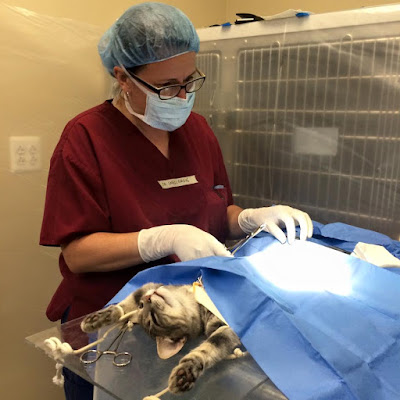
Our own Dr. Snellgrove and Vet Assistant Elizabeth Board participate in TNR clinics and love talking about their experiences in aiding outdoor felines!

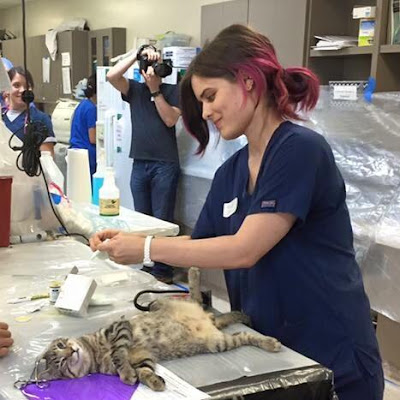
 
Here, Elizabeth is helping another volunteer to prep cats for surgery. This involves removing hair from the surgical site and scrubbing it clean.
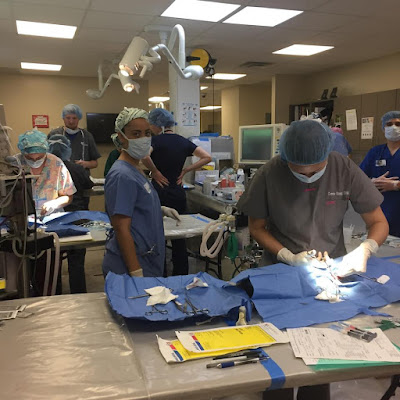
 
Here, Dr. Snellgrove (in the red top) and another doctor perform neuter and spay surgeries while technicians monitor the patients and stand by to give additional anesthesia if necessary.  The doctors have to work very fast because the felines are anesthetized with injectable medications versus gas anesthesia, to prevent any medical complications.
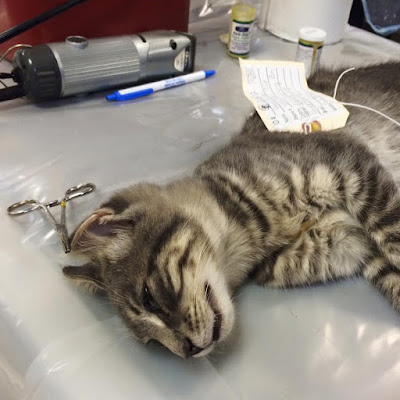
  
Don't worry, this cat is just asleep!  Each cat has an ID number and paperwork that accompanies it, so there's no worry of getting the animals mixed up.  You may also see animals laid out on trays in preparation for the surgeries - this helps cut down on time that the cats have to stay asleep so the neuter and spay surgeries can be done quickly and efficiently.  
This kitten just had her ear tipped in surgery prep (she's asleep, too!).  The clamp will stay on through her surgery and be removed in recovery.  Chances are if you see a cat with a clipped ear, it was once an outside cat who has gone through a TNR program and was adopted!

With Trap-Neuter-Return, veterinarian professionals can stabilize the feline outdoor population humanely, improve the cats’ lives, save taxpayer dollars, address neighbors’ concerns, and help the entire community reach a solution that benefits everyone!  If you are interested in helping with Trap-Neuter-Return programs, you can contact Alley Cat Allies or Metro Ferals for more information.  Here at Great Falls Animal Hospital, we work with 4Paws Rescue Team directly to care for their cats and spay and neuter them!

I hope that sheds some light on a very interesting and life-saving practice that we believe in wholeheartedly!  
Well, kittens, that's all for now.  I'm going to snuggle up here and wait for Christmas!

Til next meow,


MASON


Great Falls Animal Hospital

703-759-2330
POISON CONTROL HELPLINE
PET POISON HELPLINE: (800) 213-5774
ASPCA POISON CONTROL: (888) 426-4435

24 EMERGENCY FACILITIES
THE HOPE CENTER- Vienna: (703) 281-5121
THE LIFE CENTRE- Leesburg: (703) 777-9968

Thursday, September 4, 2014

Why Microchipping Your Pet Works

Hello, blogger fans!  It has been a long and fun summer and everything is now winding down for the fall.  That also means lots of moving, kids going to school and moving for college, and fall changes.  So, today, I would like to talk to you about microchipping.

What is microchipping, you may ask?  Well, a microchip is a tiny electronic device (about the size of a grain of rice) that uses radio waves to transmit stored information when it is read by the right kind of scanner.  Microchips for pets store a unique identification number and do not need a power source, and they have no moving parts, so they do not wear out.  Microchips are made of a material that is compatible with body tissues, so rejection and infection at the site are rare.  After injection, the microchip becomes encased in the tissue at the injection site (usually around the back and shoulders). It may move slightly, but it usually stays at or near the place it was injected.  To read the chip, a compatible scanner must be passed over it.  Different microchip companies use different chips; however, there are scanners that can read all kinds of chips.


To complete the microchipping process, you must register your pet’s microchip with the microchip company.  Unless the microchip company has your information, there is no way for the identification number on the microchip to link you with your lost pet!  This is the number one way to reunite an owner with their pet, and we here at our hospital have many happy stories about reuniting pets and owners due to a microchip and the information attached with the microchip.


So, what happens if your pet becomes lost?  When a lost or injured pet is taken to an emergency room, veterinary office, or shelter, he or she can be scanned for the presence of a microchip.  If the pet has a chip, the scanner reads the pet’s identification number.  If the chip has been properly registered, the shelter or hospital can provide the number to the microchip company, which maintains the owner's contact information.  The microchip company or hospital then contacts the owner, and the pet can be reunited with his or her family!

The use of tattoos as permanent identification for pets has for the most part been made obsolete by microchip technology.  A microchip and an ID tag, however, work best together, and I recommend that every pet have both.  The most important thing to remember about any form of pet ID is to keep your contact information current!  If you move or change your phone number, update your microchip information immediately.  Don’t wait, because a move is a high-risk time when your pet is more likely to slip out and go missing.  And get a new ID tag as well: Many pet-supply stores have machines that make them while you wait, in five minutes or less!  No excuses!

The bottom line, though, is that if your pet is lost, you want to make sure you have done everything you can to make his return home as quick and easy as possible.  You don’t want to have to rely on posters plastered around town or hope a harried shelter worker will have the time and resources to figure out where your pet belongs.  Tags, microchips and other innovative ways of identifying pets all help to produce happy endings for lost pets and their owners.


To sum up, here's why you should use a microchip as an identifier for your pet:

  • Microchips are a way of permanently identifying your pet.
  • Microchips must be registered with a microchip company to reunite you with your pet.
  • Microchipping is a simple, quick procedure that can be performed by your veterinarian.
  • Many lost pets are never returned to their owners because they do not have any form of identification.

  • To keep your pet safe in the face of the unknown, try a microchip today!  Coupled with an ID tag or ID collar, your pet will have the best chance possible to be reunited with you.  And I should know - I'm microchipped, too!


    Til next meow,
    

    Mason

    
    Great Falls Animal Hospital

    703-759-2330
    POISON CONTROL HELPLINE
    PET POISON HELPLINE: (800) 213-5774
    ASPCA POISON CONTROL: (888) 426-4435

    24 EMERGENCY FACILITIES
    THE HOPE CENTER- Vienna: (703) 281-5121
    THE LIFE CENTRE- Leesburg: (703) 777-9968
     

    Wednesday, April 16, 2014

    Spring is Here!

    It has been quite a long winter and we are so glad it is finally, finally over...finally...we hope.

    And with the Spring comes many things that you should think about for the safety of your pets and wildlife around you!


    With Easter upon us, no doubt there have been lilies and daffodils and other springtime flowers adorning your home and yard.  But did you know that some lilies are poisonous to cats and even dogs?

    There are benign and dangerous lilies out there, and it’s important to know the difference!  Benign (or non-toxic) lilies include the Peace, Peruvian, and Calla lilies, which contain insoluble oxalate crystals that cause minor signs such as tissue irritation to the mouth, tongue, pharynx, and esophagus.  Clinical signs of drooling, pawing at the mouth, foaming, and vomiting may be seen.

    The more dangerous, potentially fatal lilies are true lilies of the Lilium or Hemerocallis species.  Examples of some of these dangerous lilies include the Tiger, Day, Asiatic hybrid, Easter, Japanese Show, Rubrum, Stargazer, Red, Western, and Wood lilies – all of which are highly toxic to cats!  Even small ingestions (such as 2-3 petals or leaves) – even the pollen or water from the vase – can result in severe, acute kidney failure.  Lily of the Valley is also included and though it does not cause kidney failure, it can cause life-threatening heart arrhythmias and death when ingested by dogs or cats.

    If your cat is seen consuming any part of a lily, bring your cat (and the plant) immediately to a veterinarian for medical care.  The sooner you bring in your cat, the better and more efficiently the lily poisoning can be treated.  Decontamination (like inducing vomiting and giving binders like activated charcoal) are imperative in the early toxic stage, while aggressive intravenous fluid therapy, kidney function monitoring tests, and supportive care can greatly improve the prognosis.  Intravenous fluids must be started within an 18 hour window for the best outcome.

    Common signs to watch for if your cat has eaten lilies:
    • Inappetance
    • Lethargy
    • Hiding
    • Vomiting
    • Diarrhea
    • Halitosis
    • Dehydration
    • Inappropriate urination or thirst
    • Seizures
    • Death

     
    As springtime begins so too does “kitten season,” and Alley Cat Allies, the nation’s largest advocacy organization dedicated to cats, offers ways people can help cats and kittens this season.
     
    “If you come across a kitten outdoors, you may be tempted to bring her home with you, but that may not be the best thing for the kitten,” said Becky Robinson, president and founder of Alley Cat Allies. “Deciding whether to take a kitten home with you or leave her where she is should be carefully considered based on the individual kitten’s situation and age.”

    Alley Cat Allies offers the following tips to help kittens this season:
    1. Leave kittens with mom. Like all babies, kittens are best left with their mothers who instinctively know how to help their kittens grow up to be strong and healthy cats.  Neonatal kittens, 4 weeks old or younger, need constant care and still depend on mom for 100 percent of their food.  Kittens 5 to 8 weeks old can begin to eat wet food, but are still being weaned.  If you know the mother is present, it is best to leave kittens with her.  To determine whether the mother is caring for the kittens, wait and observe for two to four hours to see if the mother returns.  The mother could just be out looking for food. If she doesn’t return within a day, the kitten could be abandoned.  A young kitten living outdoors who does not have a mother present should be taken in and fostered.  If the kitten is not weaned, she will require bottle-feeding and round-the-clock care.
    2. Do not bring a just born kitten to an animal shelter.  Most shelter employees are not equipped or trained to provide round-the-clock care for neonatal kittens (up to 4 weeks of age).  If a kitten cannot eat on her own, she will likely be killed at a shelter.  Realistically, it is never a good idea to take a cat to a shelter.  More than 70 percent of cats who enter shelters are euthanized there, and that number rises to virtually 100 percent for feral cats taken to shelters.  


    And while we are talking about abducting or displacing cute baby animals, let's also talk about bunnies, squirrels, and birds.  The # 1 rule about wildlife is: DON'T TOUCH IT.  Unless the animal is obviously injured, emaciated, or you know the mother has not been by to take care of the babies, do not pick them up and bring them into your home as a pet.  Wild animals are not meant to be pets! 

    Signs that a wild animal needs your help:
    • A cat or dog presents the wild animal to you
    • Evidence of bleeding
    • An apparent or obvious broken limb
    • A featherless or nearly featherless bird on the ground
    • Shivering
    • A dead parent nearby
    If you observe the above signs, find help for the animal and safely capture and transport him or her to the appropriate place for treatment.  Once you're sure the animal needs your help, call a wildlife rehabilitator for assistance. If you’re unable to locate a rehabilitator, try contacting one of the following:
    • Local animal shelter or humane society
    • Animal control agency
    • Nature center
    • Veterinarian (including us!)
    Once you've contacted someone who can help, describe the animal and his physical condition as accurately as possible.  Unless you are told otherwise, here's how you can make an animal more comfortable for transport or while you're waiting for help to arrive:
    • Never handle an adult animal without first consulting with a wildlife professional. Even small animals can injure you.
    • Put the animal in a safe container. For most songbirds, a paper bag may be used for transport. For larger birds or other animals, use a cardboard box or similar container. First, punch holes for air, from the inside out, and line the box with an old T-shirt or other soft cloth.
    • Put on thick gloves and use a towel or pillowcase to cover the animal as you scoop him up gently and place him in the container.
    • Do not give the animal food or water: it may cause him to choke, develop digestive problems, or drown. Also, many injured animals are in shock, and eating or drinking can make it worse.
    • Place the container in a warm, dark, quiet place—away from pets, children, and noise—until you can transport the animal. Be sure to keep the container away from direct sunlight, air conditioning, or heat.
    • Transport the animal as soon as possible.
    • While transporting the animal, leave the radio off and keep talking to a minimum.

    With all that said, I think I'm going to find a nice spot of sun before the winter comes back...again...with snow...(grumble, grumble).

    Til next meow,
    

    Mason

    
    Great Falls Animal Hospital

    703-759-2330
    POISON CONTROL HELPLINE
    PET POISON HELPLINE: (800) 213-5774
    ASPCA POISON CONTROL: (888) 426-4435

    24 EMERGENCY FACILITIES
    THE HOPE CENTER- Vienna: (703) 281-5121
    THE LIFE CENTRE- Leesburg: (703) 777-9968
    

    http://www.cbsnews.com/news/easter-lilies-toxic-for-cats-fda-warns/

    http://www.lifewithcats.tv/2014/04/09/2-5-tips-to-help-kittens-this-spring/

    http://www.humanesociety.org/animals/resources/tips/injured_orphaned_wildlife.html#.U07ouJqPLow

    Friday, April 19, 2013

    May Greetings

    Happy April, my fellow Masoneers!  Did you look into adopting a rescued guinea pig during Adopt a Rescued Guinea Pig month?  I did, but they did a
    thorough background check and found out that I was a cat and therefore ineligible.  When I meowed that I felt I was being discriminated against, they asked if I had a steady income that would allow me to provide food, shelter and medical care and I had to be honest and say no.  They also asked if I rented or owned my residence and how much I pay per month; well, I actually cost my roommate’s money to keep me but they do because they love me. 
    J  We all came to a mutual agreement that owning a pet was not going to be in the pet’s best interest. 
    Speaking of which, did anyone else look up information on guinea pigs after reading about it?  Although it was focused on guinea pigs, the message is VERY important to anyone looking to have any kind of pet: what kind of pet is right, is it even the right time or place to have a pet right now?  That has to be the #1 reason for pets ending up in shelters and/or neglected.  The owner never did or no longer has the time or means to care for them and unfortunately, many don’t care enough to rectify the situation.  Please, please make sure that before you take on the responsibilities of having a pet, that you have the ability to meet that pet’s needs.  If you think that an adoption fee is expensive, that may be a good indication that adopting a pet is probably is not the right thing to do right now.   Food, medical care, pet rent (where applicable) and supplies are all expenses that will be in addition to your current cost of living.  When making this decision, ask yourself how long the pet would be alone during the day, how much space you have to accommodate them, type of environment, and if living with others, is everyone on board?  Let’s help shelters and animals by educating people about pet ownership so that we can reduce the number of homeless pets!
    
    Kindal and Mason
    
    Another very popular reason for pets being surrendered to shelters are allergies.  Dog and cat dander (really pet dander in general) are top reasons that many people do not own animals and why so many pet owners are on lifetime allergy medication.  Having a pet means that you are most likely having to clean more often and, depending on what you have, how much extra cleaning you need to do.  Even if you think your dog or cat doesn’t shed, think again.  Humans shed.  Sorry, the truth hurts.  How much they shed varies so if that’s an issue for you, do your research before you bring a pet home. 
    Kindal playing is up for the camera
    If you have the financial means, many people find that having hardwood floors (or something other than carpet such as tile, laminate, etc) helps tremendously for people with allergies and can also be much easier to clean.  Speaking of, is it possible to keep a clean house while being a pet owner?  The answer is a most definite yes, though a lot of that depends on the upkeep.  VeterinaryPartner.com has some good ideas; for areas that are harder to keep clean, try and cover with something that can be fairly easily washed like a small rug or furniture throw.  It also helps tremendously when you can clean up before dirt or mess spread throughout the house.  I know those dogs can be awfully messy, mud and dirt everywhere and who knows what else.  OK, I’ll admit it cats sometimes get litter in their paws and walk around the house too but we at least have a “grace” about it.  You can use baby wipes or a warm washcloth to periodically wipe our paws if you feel so inclined.  We may act like we hate it but secretly we enjoy the cleanliness!
    
    BTW Kindal is looking for a home!
    
    So is there a stain on the carpet that we may or may have not contributed to somewhere?  It would probably be advisable to try again and see if maybe another method or product can take it out.  Word around the campfire is that pets have a habit of returning to the scene of previous crimes; other’s or our own, we’re not prejudiced. 
    Here’s another newsflash:  a lot of us love to be groomed.  It also keeps some of the fur under control and not all over the rest of the house.  It’s good for bonding too.  Believe it or not, we have our Hallmark moments too!
    For more information on keeping it tidy, visit:
    Speaking of cleaning, I’m going to go try and get out of the way of my staff cleaning.  I sometimes feel kind of bad that they have to do it around me. 
    Til next meow,

    
    Mason