Mason, here! Talking to you about a very important topic with regard to felines who live outdoors. We all know the problem with feral cat colonies and cats who live outdoors: a lot of them aren't spayed/neutered and their population keeps increasing!! Trap-Neuter-Return (called TNR) is a humane and effective approach for cats living outside. Scientific studies show that Trap-Neuter-Return improves the lives of feral cats, improves their relationships with the people who live near them, and decreases the size of colonies over time.
Trap-Neuter-Return is exactly what it sounds like: Cats are humanely trapped and taken to a veterinarian to be neutered and vaccinated, and to have their ears tipped to indicate that they have been neutered and returned to the outdoors. This practice stops the breeding cycle of cats and improves their lives. Since most feral cats are not adoptable, they have been trapped by animal control services and subsequently killed in pounds and shelters due to their wild nature and lack of domesticity. Trap-Neuter-Return helps prevent the need for euthanizing these felines while allowing them to live without adding to the problem of overpopulation.
Our own Dr. Snellgrove and Vet Assistant Elizabeth Board participate in TNR clinics and love talking about their experiences in aiding outdoor felines!

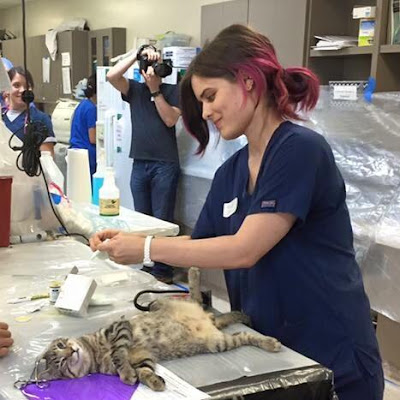
Our own Dr. Snellgrove and Vet Assistant Elizabeth Board participate in TNR clinics and love talking about their experiences in aiding outdoor felines!


Here, Elizabeth is helping another volunteer to prep cats for surgery. This involves removing hair from the surgical site and scrubbing it clean.
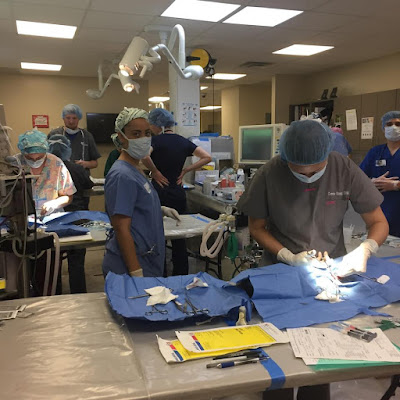
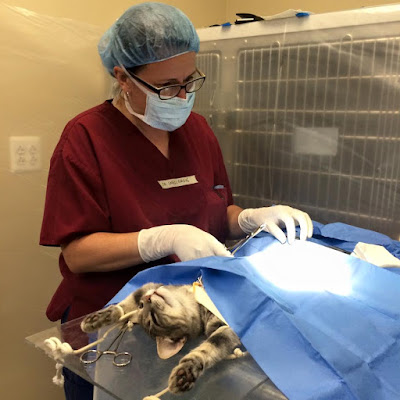


Here, Dr. Snellgrove (in the red top) and another doctor perform neuter and spay surgeries while technicians monitor the patients and stand by to give additional anesthesia if necessary. The doctors have to work very fast because the felines are anesthetized with injectable medications versus gas anesthesia, to prevent any medical complications.
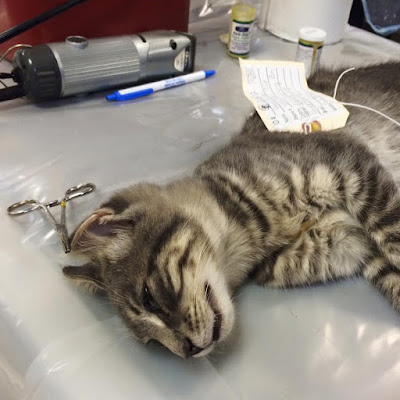

Don't worry, this cat is just asleep! Each cat has an ID number and paperwork that accompanies it, so there's no worry of getting the animals mixed up. You may also see animals laid out on trays in preparation for the surgeries - this helps cut down on time that the cats have to stay asleep so the neuter and spay surgeries can be done quickly and efficiently.

This kitten just had her ear tipped in surgery prep (she's asleep, too!). The clamp will stay on through her surgery and be removed in recovery. Chances are if you see a cat with a clipped ear, it was once an outside cat who has gone through a TNR program and was adopted!
With Trap-Neuter-Return, veterinarian professionals can stabilize the feline outdoor population humanely, improve the cats’ lives, save taxpayer dollars, address neighbors’ concerns, and help the entire community reach a solution that benefits everyone! If you are interested in helping with Trap-Neuter-Return programs, you can contact Alley Cat Allies or Metro Ferals for more information. Here at Great Falls Animal Hospital, we work with 4Paws Rescue Team directly to care for their cats and spay and neuter them!
I hope that sheds some light on a very interesting and life-saving practice that we believe in wholeheartedly! Well, kittens, that's all for now. I'm going to snuggle up here and wait for Christmas!
With Trap-Neuter-Return, veterinarian professionals can stabilize the feline outdoor population humanely, improve the cats’ lives, save taxpayer dollars, address neighbors’ concerns, and help the entire community reach a solution that benefits everyone! If you are interested in helping with Trap-Neuter-Return programs, you can contact Alley Cat Allies or Metro Ferals for more information. Here at Great Falls Animal Hospital, we work with 4Paws Rescue Team directly to care for their cats and spay and neuter them!
I hope that sheds some light on a very interesting and life-saving practice that we believe in wholeheartedly! Well, kittens, that's all for now. I'm going to snuggle up here and wait for Christmas!
Til next meow,
 |
MASON |
Great Falls Animal Hospital
703-759-2330
POISON CONTROL HELPLINE
PET POISON HELPLINE: (800) 213-5774
ASPCA POISON CONTROL: (888) 426-4435
24 EMERGENCY FACILITIES
THE LIFE CENTRE- Leesburg: (703) 777-9968
VCA SouthPaws Veterinary Specialists & Emergency Center Fairfax: (703) 752-9100


